
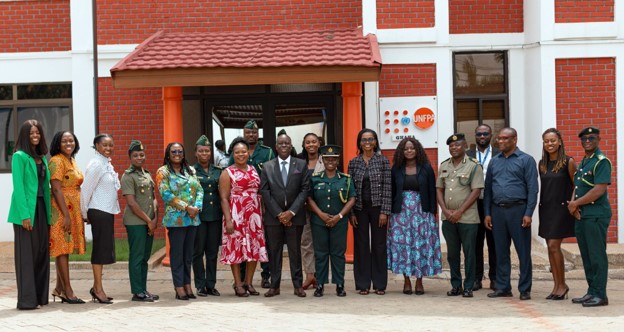
Three organisations complete evidence-based workplace assessments to strengthen gender-friendly policies and employee well-being.
By Konfidants
The Ghana Gender-Friendly Workplaces Programme has completed its maiden voluntary institutional assessment of workplace responsiveness to reproductive health and the prevention of gender-based violence. Piloted across three institutions, the assessment lays the foundation for evidence-based action to strengthen gender-responsive workplaces across Ghana.
Implemented by Konfidants in partnership with UNFPA Ghana, the programme assessed Standard Chartered Bank Ghana, the Ghana Immigration Service, and beauty salons affiliated with the Ghana Hairdressers and Beauticians Association (GHABA) in Greater Accra. These institutions were intentionally selected to reflect Ghana’s three major employment settings: the public sector, the formal private sector, and the informal economy. Together, they provide a broad picture of the opportunities and challenges involved in creating gender-friendly workplaces across different organisational contexts. The assessments examined workplace policies, employee experiences, and institutional practices relating to reproductive health, gender-based violence prevention, workplace safety, and employee well-being.
Using surveys, in-depth interviews, and focus group discussions, the programme worked closely with each institution to build a comprehensive understanding of existing strengths, gaps, and opportunities for improvement. Findings were presented to institutional leadership and UNFPA Ghana during dedicated assessment sessions in early 2026, marking the transition from research to implementation.
Evidence that drives action
The assessments were designed to help participating organisations make informed decisions about gender-friendly workplace policies and investments. Rather than serving as compliance exercises, they provide credible evidence that enables institutions to identify priorities, strengthen existing initiatives, and direct resources where they can have the greatest impact.
The pilot was intentionally designed to span Ghana’s public and private sectors, as well as the formal and informal economy. Recognising that workplace realities differ across sectors, the programme tailors its recommendations and capacity-building support to the specific needs of each institution.
By participating in the programme, each institution voluntarily opened its doors to independent assessment, encouraged employees and workers to share their experiences, and engaged leadership in reviewing the findings. This collaborative approach provides a strong foundation for meaningful organisational improvement.
By opening themselves up to the assessment, the three pilot institutions have demonstrated their commitment to strengthening workplace responsiveness to reproductive health and the prevention of gender-based violence. That commitment now provides the foundation for the next phase of the programme.
From assessment to implementation
Working alongside each institution, the programme team will support the development of priority actions, implementation roadmaps, and monitoring frameworks to track progress over time. The pilot institutions will also participate in a capacity-building intervention to help them translate the assessment findings into institution-led strategies that address identified gaps and strengthen existing workplace practices.
Through this collaborative process, the Ghana Gender-Friendly Workplaces Programme aims to strengthen participating organisations with the evidence, tools, and support needed to foster workplaces where employees can thrive and where gender-responsive practices become an integral part of organisational culture.
Next steps
Looking ahead, lessons from the pilot assessments across the public sector, the formal private sector, and the informal economy will inform the development of a capacity-building manual for HR leaders and informal-sector associations. At the same time, the assessment framework will be refined to enable institutions to conduct future assessments independently, supporting its adoption across a wider range of workplaces in Ghana.
The Ghana Gender-Friendly Workplaces Programme is implemented by Konfidants in partnership with UNFPA Ghana.
