
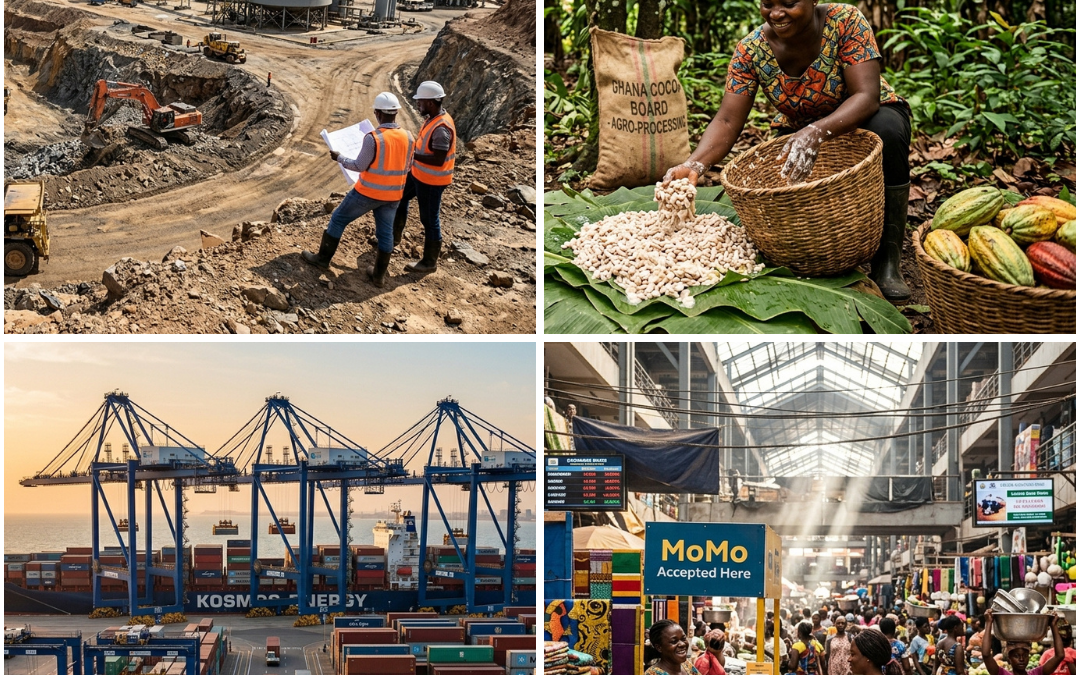
Presenting Konfidants’ mid-year review at Channel One TV’s Quarterly Economic Outlook, Managing Partner Michael Kottoh highlighted Ghana’s improving macroeconomic position. He also cautioned that rising energy costs, gold dependence, renewed borrowing and regional instability could test the recovery during the second half of 2026.
By Konfidants
Ghana has made substantial progress in restoring macroeconomic stability, but new external pressures could test the resilience of the recovery during the second half of 2026, according to Konfidants’ latest assessment of the economy.
Michael Kottoh, Managing Partner of Konfidants, presented the assessment at the second edition of Channel One TV’s Quarterly Economic Outlook on 9 July 2026, held in Accra under the theme “A Mid-Year Review of the Ghanaian Economy: Measuring Progress, Identifying Risks and Charting the Way Forward.” The presentation examined Ghana’s progress since the economic crisis of 2022, the principal external forces shaping current performance and the outlook for businesses, investors and policymakers.
The review found that Ghana entered the second half of 2026 from a considerably stronger position. Inflation had fallen sharply from a peak of about 54 per cent in 2022, easing to 3.2 per cent in March 2026. The monetary policy rate had declined to 14 per cent, economic growth reached 6.4 per cent in the first quarter of 2026, and the country had rebuilt significant external reserves. The Bank of Ghana also reported that average lending rates fell to approximately 16.3 per cent in April, compared with 27.4 per cent a year earlier.
These improvements reflect the cumulative effects of fiscal consolidation, monetary tightening, domestic and external debt restructuring and the reforms implemented under Ghana’s IMF-supported programme. In May 2026, the IMF and the Ghanaian authorities reached a staff-level agreement on the sixth and final review of the three-year, US$3 billion Extended Credit Facility, with the final disbursement due to go before the IMF Executive Board in August 2026; engagement is now shifting to a non-financing Policy Coordination Instrument as direct Fund financing ends. The IMF has described the programme as having delivered substantial stabilisation gains, including lower inflation, stronger reserves, greater confidence in the cedi and a marked reduction in the public-debt ratio, noting that the external position strengthened on the back of historically high gold export receipts.
Stability has not eliminated business pressures
Konfidants’ review nevertheless distinguished between improving macroeconomic indicators and the operating conditions businesses experience.
The cost of capital has fallen substantially, while the removal or consolidation of selected taxes has eased some of the burden on firms. A stronger cedi has also lowered the local-currency cost of many imported goods and inputs.
However, energy and utility costs have continued to rise. The Public Utilities Regulatory Commission raised electricity tariffs by 9.86 per cent and water tariffs by 15.92 per cent from January 2026 under the 2026–2030 Multi-Year Tariff Order, with further quarterly adjustments tied to the exchange rate, fuel costs and inflation; Kottoh noted that industrial electricity tariffs have risen by roughly 23 per cent and water by about 19 per cent since 2024. Higher fuel costs and administrative difficulties at the ports remain important sources of pressure. Credit, although much cheaper than it was two years ago, also remains expensive for many Ghanaian businesses.
For firms, therefore, Ghana’s stabilisation is producing real benefits, but these gains are uneven. Lower interest rates and a stronger currency improve financing and import conditions, while rising energy, transport and utility costs work in the opposite direction.
Gold has become Ghana’s most powerful external buffer
The review identified historically high gold prices and record export receipts as the strongest immediate support for the economy. Higher gold earnings have strengthened the trade and current-account balances, helped rebuild reserves and provided support for the cedi.
Gross international reserves reached about US$14.5 billion (equivalent to 5.8 months of import cover) by the end of February 2026 before easing to around US$14 billion (5.7 months) by mid-year, up from US$13.8 billion at the end of 2025. Ghana also recorded a current-account surplus of US$9.1 billion in 2025, up from US$1.5 billion in 2024.
But this strength also creates a vulnerability. A large share of Ghana’s recent external-sector improvement rests on one commodity whose price is determined internationally. Gold set successive records earlier in 2026 before easing to around US$4,100 an ounce by the time of the review, still well above year-earlier levels, but a reminder of how quickly the picture can shift. A substantial correction in gold prices would weaken export receipts, reserves and support for the currency simultaneously.
The central policy challenge is consequently to convert the gold windfall into a more diversified and durable base of export earnings and productive investment.
Remittances and non-traditional exports provide additional resilience
Remittances represent another important source of stability. Inflows from Ghanaians abroad are estimated to have reached a record US$7.8 billion in 2025, around three times the value of foreign direct investment.
Unlike many portfolio and investment flows, remittances tend to remain relatively stable during periods of uncertainty. They support household consumption, provide foreign exchange and reduce Ghana’s dependence on more volatile sources of external financing.
The review also highlighted the growing contribution of non-traditional exports. Earnings crossed US$5 billion for the first time in 2025 (about US$5.01 billion, up 30.7 per cent on 2024), strengthening Ghana’s prospects for reaching its US$10 billion target by 2030.
Opportunities include greater access to African markets under the AfCFTA and China’s expanded tariff-free access for African exports, which took effect on 1 May 2026 and allows Ghanaian goods such as cocoa previously subject to tariffs of 8 to 22 per cent—to enter China duty-free. Capturing these opportunities will require more investment in processing, market research, product standards, logistics and relationships with buyers in destination markets.
New risks are emerging beyond Ghana’s borders
The second half of the year will be shaped increasingly by developments outside Ghana.
Oil-price volatility presents the most immediate risk. Ghana exports crude oil but remains dependent on imported refined petroleum products, making higher international prices a direct source of fuel, transport and inflationary pressure. The rise in headline inflation to 5.3 per cent in June, a third consecutive monthly rise, though still far below the 13.7 per cent of a year earlier, and linked by the Bank of Ghana to higher fuel prices as the Middle East conflict disrupted supply through the Strait of Hormuz, demonstrated how quickly external energy shocks can affect domestic prices.
Cocoa remains another source of uncertainty. International prices fell sharply after reaching exceptional levels, exposing farmers, public finances and the wider cocoa-financing system to a difficult adjustment. Futures collapsed from a December 2024 peak near US$12,900 a tonne to a cycle low around US$2,850 in early 2026, before recovering to roughly US$4,000–US$4,400 by mid-year. Recent price recovery and efforts by Ghana and Côte d’Ivoire to coordinate producer policy offer some relief, but the sector remains highly exposed to international market movements.
Regional instability is also becoming an economic issue. Burkina Faso is an important regional market for manufactured and non-traditional exports, while Ghanaian ports serve trade moving into the Sahel. Kottoh cited Burkina Faso’s restrictions on tomato exports as a possible source of food-price pressure in Ghanathough also an opportunity to expand domestic production and agro-processing. Insecurity, trade restrictions and competition from alternative transit routes could weaken these commercial flows while increasing Ghana’s security expenditure.
Kottoh flagged further external risks beyond commodities: continued uncertainty over global trade and United States tariff policy, and the possibility that a sharp unwinding of the artificial-intelligence investment boom could tip the US economy and, in turn, global demand into a downturn.
A stronger economy, but no room for complacency
Konfidants expects Ghana’s economy to remain broadly stable during the second half of 2026. Growth is projected to moderate from its strong first-quarter performance. The IMF projects full-year 2026 growth of about 4.8 per cent, while some local analysts expect it to stay above 6 per cent, and reserves and the current-account surplus should continue to provide support for the cedi. The Bank of Ghana’s Monetary Policy Committee was due to announce its next rate decision on 22 July 2026, with analysts widely expecting the 14 per cent policy rate to be held amid renewed inflation risks.
However, the recovery faces several tests: higher energy costs, renewed imported inflation, the gradual return to borrowing, a possible weakening of domestic business activity and the country’s growing reliance on gold.
For businesses, the immediate priority is to manage exposure to fuel prices, import costs, exchange-rate movements and financing conditions. Investors face improving opportunities in gold, cocoa processing and export-oriented industries, but must account for financing and commodity-price risks.
For policymakers, the task is to preserve fiscal and monetary discipline while using the current period of stability to diversify exports, strengthen domestic production and reduce dependence on temporary commodity windfalls.
Ghana has rebuilt important economic buffers. The durability of the recovery will now depend on whether those buffers can be converted into broader competitiveness, productive investment and more diversified sources of growth.
