
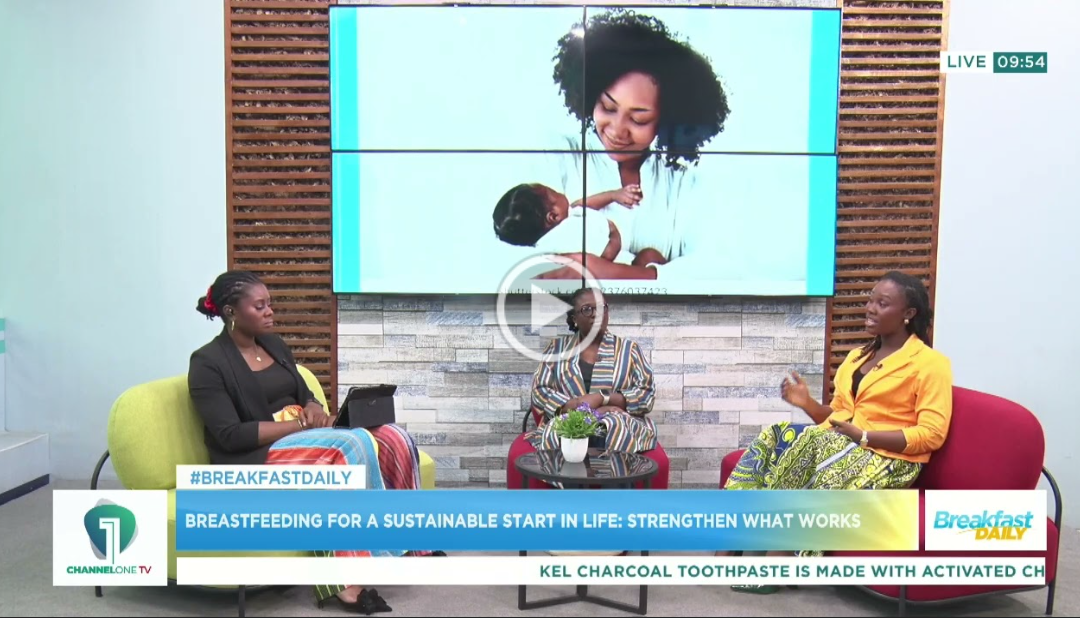
Konfidants partnered with Channel One TV and Citi FM to expand national advocacy for workplace systems that enable mothers to continue breastfeeding after returning to work.
The campaign formed part of activities marking World Breastfeeding Week 2026. It is a sister initiative to the Ghana Gender-Friendly Workplaces Programme, implemented by Konfidants in partnership with UNFPA Ghana, and similarly seeks to strengthen workplace systems that support women’s health, well-being and continued participation in the workforce.
Through television, radio and digital engagement, the campaign connected breastfeeding support with wider issues affecting women’s participation in the workforce, including employee well-being, staff retention and organisational productivity. It also highlighted the practical role employers can play in ensuring that support for mothers extends beyond maternity leave.
Taking the conversation to a wider audience
Appearing on Channel One TV’s Breakfast Daily, Adadzewa Otoo and Naomi Baffour Gyau discussed why breastfeeding-supportive workplaces matter and what employers can do to improve the experience of nursing mothers.
The conversation highlighted practical measures such as dedicated lactation spaces, flexible working arrangements and family-friendly workplace policies. These measures can ease the transition back to work, support the health and well-being of mothers and children, and help organisations retain skilled employees.
The campaign provided an important opportunity to bring the workplace dimensions of breastfeeding to a wider public audience and encourage employers and institutions to consider the practical support available to nursing mothers.
Benefits for mothers, children and employers
Breastfeeding provides important protection against childhood infections and illnesses and offers health benefits to mothers following childbirth. Returning to work without adequate support, however, can make it difficult for women to continue breastfeeding and may expose them to physical discomfort, frequent disruption and anxiety about their children’s care.
Breastfeeding-supportive workplaces can help address these challenges. For employers, appropriate support can improve the return-to-work experience, promote employee well-being, strengthen retention and protect investments made in developing skilled staff.
The wider economic significance
Supporting women to remain economically active also has implications beyond individual workplaces. Analysis of the Ghana Statistical Service’s Annual Household Income and Expenditure Survey shows that women held about 53 per cent of employment in Ghana in 2022. The data further show that women leave the labour force in greater numbers because of pregnancy-related responsibilities and household duties.[1]
When women are unable to remain economically active, the consequences can affect household incomes, children’s welfare, organisational performance and government revenue.
Strengthening workplace support
The 2026 World Breastfeeding Week theme, “Breastfeeding for a Sustainable Start in Life: Strengthen What Works,” reinforced the importance of building on practical systems that protect and support mothers and children.
For workplaces, this means creating conditions in which women are not forced to choose between continuing to breastfeed and pursuing their careers. Supporting nursing mothers is an investment in healthier families, more productive employees, stronger organisations and a more resilient national workforce.
The initiative will build on this advocacy through follow-up activities designed to help institutions strengthen and implement breastfeeding-friendly workplace practices.
Watch Adadzewa Otoo and Naomi Baffour Gyau on Channel One TV’s Breakfast Daily to learn more about breastfeeding-supportive workplaces and the practical steps employers can take: https://www.youtube.com/watch?v=unqzr7fpdeE
Konfidants appreciates Channel One TV and Citi FM for supporting this important advocacy and UNFPA Ghana for its continued partnership in advancing more responsive and gender-friendly workplaces.
The Ghana Gender-Friendly Workplaces Programme is implemented by Konfidants in partnership with UNFPA Ghana.
[1] https://mpra.ub.uni-muenchen.de/120311/1/MPRA_paper_120311.pdf
